
Second-hand women's road bike: size and geometry before the label
Alberto Martínez Martín, editor of bicis.net 4 min read
In this article
If you've typed "second-hand women's road bike" into a search engine, what you're after is a bike that fits you. For years, several brands sold specific models with different colours, a different saddle and slightly different geometry. Today almost all of them have gone back to a single frame with more small sizes. On the second-hand market you'll find both, and what really matters is the size, not the label.
What changes in a "women's" road bike
When a road bike is sold as a women's bike, this is usually what changes:
- Smaller sizes, sometimes with 650c wheels on the smallest sizes so the geometry stays balanced.
- Shorter reach: the distance from saddle to handlebar is shorter, and so is the stem.
- Narrower handlebars and levers closer to the bar for small hands.
- Shorter cranks and a saddle that's wider at the back.
None of that belongs to anyone in particular. If you're short, have short arms or small hands, it may fit you better than a "unisex" bike. And if a size XS unisex fits you perfectly, that works too. Body first, label second.
Size and geometry above all
On a road bike you spend hours in the same position. The wrong size shows up in your neck, your back and your hands, however good the bike is.
How to get the size right
- Look at the geometry chart for the model and year: the stack (height) and reach tell you more than the size printed on the frame.
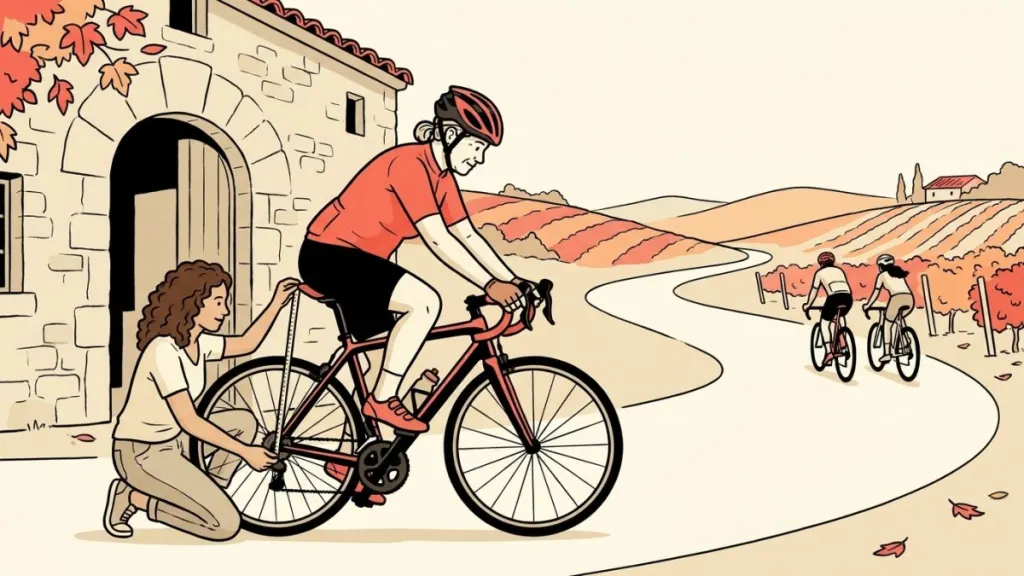
- Get on and put your hands on the hoods: you should reach them without locking your arms or hunching your back.
- Standing over the bike, there should be some space between your crotch and the top tube.
- As a very rough guide: size XS or a 47–49 cm frame up to 1.60 m; S or 50–52 cm from 1.60 m to 1.70 m; M or 53–55 cm from 1.70 m to 1.80 m. Every brand measures differently: always check its chart.
What you can fix and what you can't
The stem, handlebar, saddle and cranks can be swapped for little money. The frame can't. If the frame is your size and you're not keen on the rest, it's a good buy. If the frame is too big, no short stem will fix it.
What to check before you pay
Frame and fork
In good light, look at the tube joints, the bottom bracket area, the stays and the fork. On carbon, look for fine cracks, knocks and spots where the paint sounds different when you tap it with a fingernail. On aluminium, look at the welds. Always ask whether it's been crashed.
Drivetrain
Shift through every sprocket on both chainrings. Measure chain wear with a chain checker or ask a workshop to do it. A worn chain usually comes with worn sprockets and chainrings, and that adds up.
Brakes and wheels
If they're discs, check the rotors aren't too thin or bent and the pads have material left. If they're rim brakes, check the wear on the braking surface. Spin the wheels: they shouldn't wobble and the hubs shouldn't make noise.
Where it came from
Ask for the invoice or proof of purchase and the frame number, and check it against the stolen bike alerts on bicis.net before you meet.
Give it a proper test ride
A two-minute spin down the street isn't enough. Ask to ride for at least ten or fifteen minutes, with a hill if there's one nearby. Climb out of the saddle, brake hard on a descent and take one hand off to drink: that way you'll know whether the bike is stable and whether the position lets you do it comfortably. Bring your own pedals and shoes if you use clipless, or ask to borrow some.
Notice how you feel at the end: if your hands are numb or your neck is tight after so little time, the size or the reach isn't right for you. And if you're torn between two sizes, on a road bike the smaller one usually works better: it's easier to lengthen with a stem than to shorten.
How much people ask for a used road bike
This is what sellers of road bikes on bicis.net are asking. It's the asking price, not the final one.
| Category | Listings | Median price (€) | Cheapest quarter up to (€) | Most expensive quarter from (€) |
|---|---|---|---|---|
| Road | 44 | 1,150 | 673 | 2,924 |
Data as of 9 November 2026, from Cycling in figures (n = 231 listings). Small sizes tend to have fewer listings, so it may sometimes take longer to find yours; don't overpay for it. To see whether a price is reasonable, try the bike valuer with the model and year.
Where to look
Browse the second-hand road bikes and filter by your area. If you're after an e-bike, there's the guide to second-hand step-through e-bikes. Always ask for the size in centimetres and the year before you meet: it saves you trips.
Frequently asked questions
Is a women's road bike different from a regular one?
It usually has smaller sizes, a shorter reach, a narrower handlebar and a different saddle. It suits anyone it fits; what matters is the size and the geometry.
What size road bike do I need if I'm short?
As a guide, up to 1.60 m an XS or a 47 to 49 cm frame usually works. Look at the model's stack and reach and try it with your hands on the hoods.
How much does a second-hand road bike cost?
On bicis.net the median is €1,150 and half the listings are between €673 and €2,924 (44 listings, data as of 9 November 2026).
Can I adapt a small unisex bike?
Yes: the stem, handlebar, saddle and cranks can be swapped for little money. What you can't change is the frame, so get its size right.
Spotted a mistake? Write to us at info@bicis.net and we’ll fix it. Who writes bicis.net and how we work
El plan del finde, every Thursday
The weather for riding, routes and group rides near you, in your inbox.
When you sign up, tick «I want El plan del finde». One email every Thursday; unsubscribe with one click. Already have an account? Log in
Comments
What do you think? Create your free account to comment.