
What size bike do I need? Size guide for road, mountain and gravel bikes
bicis.net editorial team 2 min read
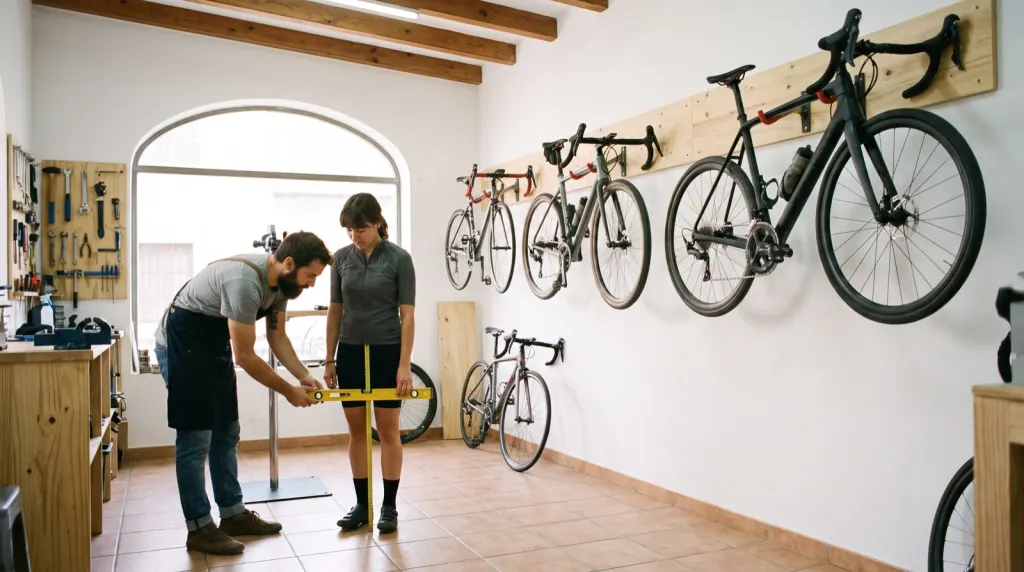
Size is the one thing you can't fix by swapping components. A bike that's too big or too small is uncomfortable, less efficient and, in the long run, can give you back, knee or neck pain. Second-hand, there's usually no returning it either, so it pays to get it right first time.
Measure properly: height and inside leg
You need two measurements:
- Height, barefoot and with your back against the wall.
- Inside leg: standing barefoot with your feet about 15 cm apart. Place a book between your legs, pushing it up as if it were a saddle, and measure from the spine of the book to the floor.
Inside leg is more reliable than height, because two people of the same height can have very different legs and torsos.
Road bikes
A classic starting formula is: inside leg (cm) × 0.665 = frame size in cm. With an 82 cm inside leg, you'd get a frame of around 54-55 cm.
| Height | Approximate size | Frame (cm) |
|---|---|---|
| 155-165 cm | XS | 48-51 |
| 165-172 cm | S | 52-53 |
| 172-180 cm | M | 54-56 |
| 180-188 cm | L | 57-58 |
| 188-196 cm | XL | 59-61 |
Mountain bikes (MTB)
Mountain bikes use more compact sizes for better control. A common guide: inside leg (cm) × 0.226 = size in inches. Today almost every brand uses letters.
| Height | Approximate size | Inches |
|---|---|---|
| 150-165 cm | S | 15-16" |
| 165-177 cm | M | 17-18" |
| 177-188 cm | L | 19-20" |
| 188 cm or more | XL | 21-22" |
Gravel bikes
Gravel bikes are sized like road bikes, but their geometry is usually a little taller and more relaxed. If you're between two sizes and you'll do long rides or bikepacking, the smaller one with a slightly longer stem is usually more versatile; if you want comfort and an upright position, go for the larger one.
Beyond the chart: stack and reach
Every brand measures its frames its own way, so an "M" from one brand can feel like an "S" from another. To compare properly, look at two geometry figures that every manufacturer publishes:
- Stack: height of the head tube relative to the bottom bracket. More stack, more upright position.
- Reach: horizontal distance from the bottom bracket to the head tube. More reach, more stretched-out position.
If your current bike fits you well, look up its stack and reach and compare them with the bike you're interested in. Differences of 1-2 cm can be fine-tuned with the stem, spacers and saddle.
Check the size on the test ride
- Standing over the top tube with your feet flat, there should be a clearance of about 2-5 cm on a road bike, and more on a mountain bike.
- With the saddle at your height, your leg should be almost straight with the pedal at the bottom, without your hips rocking.
- Holding the handlebar, your arms should be slightly bent, without putting weight on your hands.
Search by size on bicis.net
In the search you can filter by size in each category: road, mountain or gravel. And if you're unsure about a listing, ask the seller how tall the previous rider was: it's a really useful detail.
The charts are only a guide. For a precise fit, especially if you train for many hours, a professional bike fit is the best investment.
Comments
What do you think? Create your free account to comment.