
Second-hand turbo trainer: what to check before you pay and what people ask
Alberto Martínez Martín, editor of bicis.net 5 min read
In this article
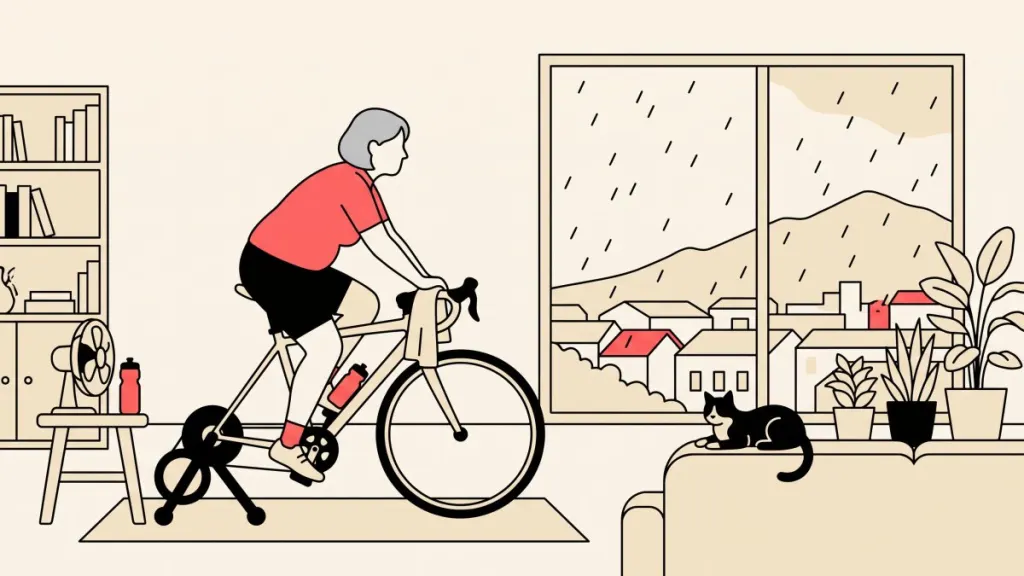
If you're looking for a second-hand turbo trainer, now is a good time: the short evenings, the rain and the cold are arriving, and plenty of people are selling the one they bought and barely used. Chosen well, a used trainer lets you keep pedalling all winter without spending what a new one costs. Here's which type suits you, what to check before you pay and what people ask on bicis.net.
Which type of trainer suits you
Before you look at listings, be clear about what you want to do at home. Turning the pedals to keep fit isn't the same as following a training plan or riding in an app with other cyclists.
Rollers
Three drums you rest the bike on without clamping it. You work on balance and pedalling smoothness, but they take some getting used to and aren't suited to hard intervals. There's little mechanics to them: check that the drums spin true and that the belt isn't cracked.
Wheel-on trainers with magnetic or fluid resistance
You clamp the rear axle and the wheel rests on a roller that provides resistance. Magnetic ones are simple and a bit noisier; fluid ones give a feel closer to the road. They're the cheapest option and don't need power.
Smart wheel-on or direct-drive trainers
They connect to your phone, tablet or computer and adjust the resistance on their own. With direct-drive ones you remove the rear wheel and mount the bike on the trainer's cassette: they're quieter, don't wear your tyre and measure more accurately. They're the most sought-after second-hand and the ones that need checking most.
What to check before you pay
Meet the seller and test it with your own bike. If you can't bring it, at least ask them to show you it working with another bike.
That it fits your bike
- The axle: check whether your bike has a quick release or a thru-axle and whether the trainer comes with the adapters for yours. If they're missing, ask at the shop first how much they cost.
- Cassette and freehub: on direct-drive trainers, the trainer's cassette must have the same number of speeds as your bike, and the freehub must be the same system (Shimano, SRAM or Campagnolo). If it has no cassette, add that to the price.
- Wheel size: on wheel-on trainers, make sure it takes your bike's wheel, whether road, gravel or mountain.
That it spins well
- Pedal for a few minutes at an easy pace and then push hard. Listen: a constant hum is normal; knocks, squeaks or a noise that changes with every revolution are not.
- Move the flywheel or the axle by hand: there should be no play.
- If it has an internal belt, ask whether it has ever been changed. Slipping when you start hard is a sign it's worn.
- The legs must open and close properly and keep the trainer stable, without rocking.
That it connects and calibrates (if it's smart)
- Connect it to your app via Bluetooth or ANT+ and check that the resistance changes on its own when you ride up a virtual hill.
- Run the calibration its app asks for: if it doesn't complete, be wary.
- Ask them to update the firmware in front of you or to confirm it's up to date.
- Check that it comes with its original power supply and cable.
The paperwork
Ask for the invoice: it tells you the purchase date, the exact model and whether any warranty is left. Also check the serial number, usually on a sticker on the base or body. If something doesn't add up, such as a very low price with no invoice or explanation, don't rush.
What people ask on bicis.net
bicis.net doesn't yet have a separate category for turbo trainers: they go under accessories and sometimes components. This table gives you a reference for what sellers ask, not the final price, from active listings as of 11 November 2026.
| Category | Listings | One in four asks less than (€) | Median (€) | One in four asks more than (€) |
|---|---|---|---|---|
| Accessories | 17 | 20 | 60 | 150 |
| Components | 8 | 140 | 275 | 395 |
| Road (bikes) | 47 | 740 | 1,200 | 2,948 |
Source: Ciclismo en cifras, bicis.net, data as of 11 November 2026. The accessories category mixes everything from lights to bike racks, so a set of rollers or a magnetic trainer fits closer to its median, while a smart direct-drive trainer is usually listed well above it. To fine-tune, compare the listing with the price of the same model new and knock off for age, use and anything missing (cassette, adapters, mat).
How to make the most of it this winter
- Put a mat under it: it protects the floor from sweat and cuts vibration for the neighbours.
- A fan in front: there's no wind at home and you sweat much more than outdoors.
- Short sessions with a plan: three sessions with a goal are better than one long hour staring at the wall.
- Get out when the weather allows: the trainer is for the bad days. If you fancy riding in the cold, see what to wear from 15 °C to 0 °C, layer by layer.
And if you're getting a trainer because you're changing bikes, you can work out what yours is worth with the bike valuation tool and read what to check on a second-hand road bike before you buy the next one.
Frequently asked questions
Is it worth buying a second-hand smart trainer?
Yes, if you test it first: it should connect to your app, change resistance on its own, calibrate and make no strange noises. Ask for the invoice to know its age and whether any warranty is left.
Will any trainer work with my bike?
Not always. Check whether your bike has a quick release or a thru-axle and whether the trainer comes with the adapter. On direct-drive trainers, the cassette must match your bike's speeds and system.
How much should I pay for a used trainer?
It depends on the type. As a reference, accessories for sale on bicis.net ask a median of €60 (17 listings, data as of 11 November 2026); a smart direct-drive trainer is usually listed for quite a bit more. Compare it with the price of the same model new.
What noise is normal on a trainer?
A soft, steady hum that rises with speed. Knocks, squeaks or a noise that changes with every revolution are usually worn bearings or a worn belt.
Spotted a mistake? Write to us at info@bicis.net and we’ll fix it. Who writes bicis.net and how we work
El plan del finde, every Thursday
The weather for riding, routes and group rides near you, in your inbox.
When you sign up, tick «I want El plan del finde». One email every Thursday; unsubscribe with one click. Already have an account? Log in
Comments
What do you think? Create your free account to comment.