
Bike lights in winter: what the law requires and how many lumens you need
Alberto Martínez Martín, editor of bicis.net 5 min read
In this article
Since the clocks went back, the afternoon runs out before your ride does. In winter almost every weekday ride starts or ends in low light, and that's when bike lights stop being an accessory: they're what makes you seen and what lets you spot the pothole in time. Here's what the law requires, taken from the official texts, and how many lumens you need depending on where you ride.
What the law requires
The rules are in two texts: the Reglamento General de Circulación (General Traffic Regulations, article 98) and the Reglamento General de Vehículos (General Vehicle Regulations, its annex on bicycle lighting). In short, without the small print:
- When: between sunset and sunrise, in tunnels and underpasses and on stretches with the tunnel sign. Also in fog, heavy rain or anything else that greatly reduces visibility.
- What to have on the bike: a white position light at the front, a red position light at the back and a red rear reflector that isn't triangular. Spoke and pedal reflectors are optional, but they help.
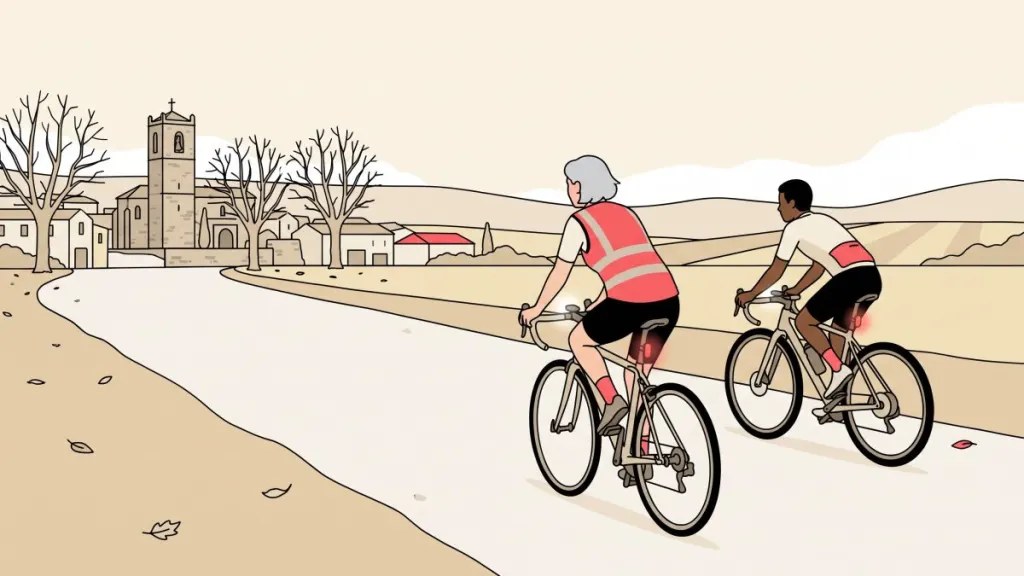
- What to wear: if lights are compulsory and you're on an interurban road, you must wear a reflective garment that makes you visible at 150 metres. A vest or a jacket with reflective strips will do.
- Flashing lights: the DGT clarified in a 2018 instruction that bikes may use flashing lights as long as they don't dazzle. The sensible choice: flashing at the back; steady at the front when you need to see the way.
Not using lights when you should is a serious offence under the Ley de Tráfico y Seguridad Vial (Traffic and Road Safety Act), and you can be fined. But what you're really risking isn't the fine: it's a car seeing you too late.
How many lumens you need depending on where you ride
Lumens measure how much light the lamp gives. There's no official figure: the law asks for light, not power. These ranges are a guide and come from how each lamp is used in practice:
| Where you ride | Front light (lumens) | Rear light (lumens) | What for |
|---|---|---|---|
| Town with street lights | 100–300 | 20–50 | Being seen at junctions and roundabouts |
| Road at night without street lights | 400–800 | 50–100 | Seeing the verge and potholes at your speed |
| Gravel on tracks | 800–1,200 | 50–100 | Reading loose stones and ruts |
| Mountain biking on trails | 1,000–1,500 on the bar and 300–800 on the helmet | 50–100 | Lighting the bend before you turn the bar |
| By day (daytime light) | 200 or more, flashing | 100 or more, flashing | Being seen among shadows and backlight |
Three things matter as much as lumens:
- The beam: on the road, a lamp with a cut-off at the top is better, like car headlights. It lights the tarmac and doesn't blind oncoming traffic.
- Real battery life: the cold eats battery. Check how long it lasts in the mode you'll use, not the lowest one, and charge the lamp the night before.
- The mount: a light that swivels on every bump ends up pointing at the sky or at your wheel.
Road, gravel or town: how to fit them
On the road
At the front, a lamp with a cut-off beam at handlebar height. At the back, a red one on the seatpost or saddle, and if you can a second on your backpack or helmet: if one goes out, you still have the other. Before you set off, check the forecast for your area in riding weather: winter morning fog means you need your lights even in daytime.
On gravel and mountain trails
The bar light points where the bike goes; the helmet light, where you look. With both you see the bend before you enter it. If you're looking for somewhere to try them out, in the gravel routes you have routes with measured surfaces so you can pick a short one midweek.
In town
With street lights you don't need a mountain lamp, but you do need to be seen from the side: spoke reflectors, reflective bands on your ankles and backpack and a rear light that shows up well at traffic lights.
Greenways with tunnels: lights even at midday
Many greenways were railway lines and keep their tunnels. The law requires lights in tunnels at any time, and besides, inside you can't see the ground. The Vía Verde de la Sierra, between Puerto Serrano and Olvera, goes through several: switch your light on as you enter each one. These are some of the longest on bicis.net, so you can work out the battery you need if evening catches up with you:
| Greenway | Region | Km | Elevation (m) |
|---|---|---|---|
| Vía Verde Ojos Negros | Aragón | 183.5 | 531 |
| Vía Verde del Noroeste | Región de Murcia | 72.5 | 752 |
| Vía Verde de la Sierra: Puerto Serrano a Olvera | Andalucía | 39.1 | 493 |
Data from «Ciclismo en cifras» as of 5 November 2026 (n = 68 greenways). © OpenStreetMap contributors. Full page for the Vía Verde de la Sierra: Puerto Serrano a Olvera.
Winter sportives: rides in low light
The calendar doesn't stop in winter, and many events start first thing, before it's fully light, or finish with the sun very low. These are the events per month in the bicis.net calendar (data as of 5 November 2026):
| Month | Events |
|---|---|
| November 2026 | 30 |
| December 2026 | 10 |
| January 2027 | 12 |
| February 2027 | 18 |
If you drive to the start and ride back, or if the event is long, pack your lights even if the organisers don't require them.
Before every winter ride
- Charge your lights the night before and carry a small spare rear light.
- Check that the front light points at the ground a few metres ahead, not into anyone's eyes.
- Carry the reflective vest or jacket in your pocket even if you set off in sunshine.
- Plan your return around sunset: if in doubt, shorten the route. In our guide to the clock change you'll find what time it gets dark in each city.
Frequently asked questions
Do I have to use bike lights during the day?
No, except in tunnels, underpasses and when visibility is poor (fog, heavy rain). Even so, a flashing rear light by day makes you much more visible on the road.
Can I use my rear light in flashing mode?
Yes. The DGT clarified in 2018 that bikes may use flashing lights as long as they don't dazzle others.
How many lumens do I need for riding on the road at night?
As a guide, between 400 and 800 lumens at the front with a beam that doesn't dazzle, and a rear light of 50 to 100 lumens. In town with street lights you need less.
Do I have to wear a reflective vest on the bike?
Yes when lights are compulsory and you're riding on an interurban road: the law requires a reflective garment that makes you visible at 150 metres. In town it isn't compulsory, but it helps.
What happens if I ride without lights when they're compulsory?
It's a serious offence under the Ley de Tráfico y Seguridad Vial and you can be fined. And, above all, cars see you much later.
Official sources: Reglamento General de Circulación (BOE), Reglamento General de Vehículos (BOE) and Ley de Tráfico y Seguridad Vial (BOE).
Sources for this article
- Reglamento General de Circulación (BOE) · boe.es
- Reglamento General de Vehículos (BOE) · boe.es
- Ley de Tráfico y Seguridad Vial (BOE) · boe.es
- Routes and maps: © OpenStreetMap contributors
Spotted a mistake? Write to us at info@bicis.net and we’ll fix it. Who writes bicis.net and how we work
El plan del finde, every Thursday
The weather for riding, routes and group rides near you, in your inbox.
When you sign up, tick «I want El plan del finde». One email every Thursday; unsubscribe with one click. Already have an account? Log in
Comments
What do you think? Create your free account to comment.